



BOEM’s Center for Marine Acoustics helps inform the bureau’s approach for developing monitoring and mitigation requirements for offshore projects. The goal of monitoring and mitigation is to reduce potential harm to marine life from exposure to underwater noise. By using the best available science to inform these requirements, the CMA brings a practical and predictable approach for industry.

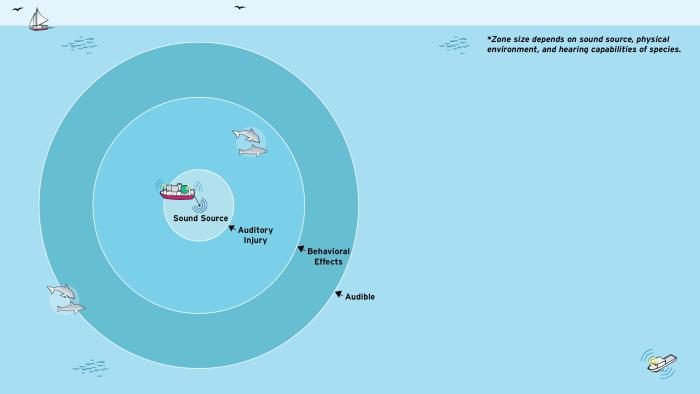
BOEM generally follows the following mitigation hierarchy for offshore activities:
Avoid noise-generating activities when sensitive species are present.
This is generally accomplished through time-area closures or exclusion areas. These closures or exclusions can be permanent (due to the presence of sensitive species and habitats) or temporary (during periods when protected or sensitive species are most prevalent).
Reduce harmful types of noise at the source.
This can be accomplished by either:
- Choosing alternative sound sources that still accomplish the goal at hand. For example, choosing low-noise foundation types and installation methods (e.g., gravity-based foundations or vibratory pile driving) or choosing an alternative to a seismic airgun that has less acoustic energy in the bandwidth that marine species can hear.
- Applying noise abatement technologies, which reduce noise propagation through the water column once it has been generated. To date, multiple noise abatement technologies or systems have been deployed in Europe and the United States to reduce noise associated with fixed-bottom offshore wind pile driving. Examples include bubble curtains and variations; pipe-in-pipe systems; hydro sound dampers; and noise mitigation screens. These may be placed either near-to-pile or far-from-pile. For more information, see this technical report commissioned by the Federal Maritime and Hydrographic Agency in Germany.
Implement rigorous real-time monitoring during noise-generating activities and shut down activities when an animal is within a certain distance.
This is generally accomplished through multiple methods:
- Protected Species Observers (PSOs): PSOs are visual observers trained to identify protected marine species using large, high-powered binoculars (also known as bigeye binoculars). Typically, several PSOs are deployed during each offshore operation. When a PSO detects a protected species within the clearance zone, operations are delayed until the species exits the zone. If operations are already underway and a protected species is detected within the shutdown zone, the sound source must be shut down until the species exits. PSOs are also often utilized to mitigate the risk of vessel strikes with marine species.
- Real-time Passive Acoustic Monitoring (PAM): Real-time PAM systems continually record sounds in the vicinity of an operation. The system’s onboard software can detect vocalizations of nearby protected species. When the system detects a protected species, the PAM operator can call for a shutdown or a delay in operations, depending on the species’ proximity to the activity.
Monitor the acoustic environment.
This is typically accomplished through two methods:
- Sound Field Verification (SFV) of certain noise sources. This is a process that compares multiple real-time measurements of the acoustic environment (the sound field) against predicted activity-related sound levels to ensure that developers stay within their allowable limits. Since the propagation of underwater sound is highly influenced by environmental conditions, BOEM recommends operators conduct measurements in multiple locations to ensure this variability is captured. Since the propagation of underwater sound is highly influenced by environmental conditions, BOEM recommends operators conduct measurements in multiple locations to ensure this variability is captured. For BOEM’s guidance on conducting SFV during offshore wind construction, please see this document.
Long-term Passive Acoustic Monitoring. Archival PAM systems passively record sounds for extended periods of time, beyond the time when noise-producing activities have occurred. Archival systems illustrate large-scale, long-term changes in the soundscape, including anthropogenic and biological activity.
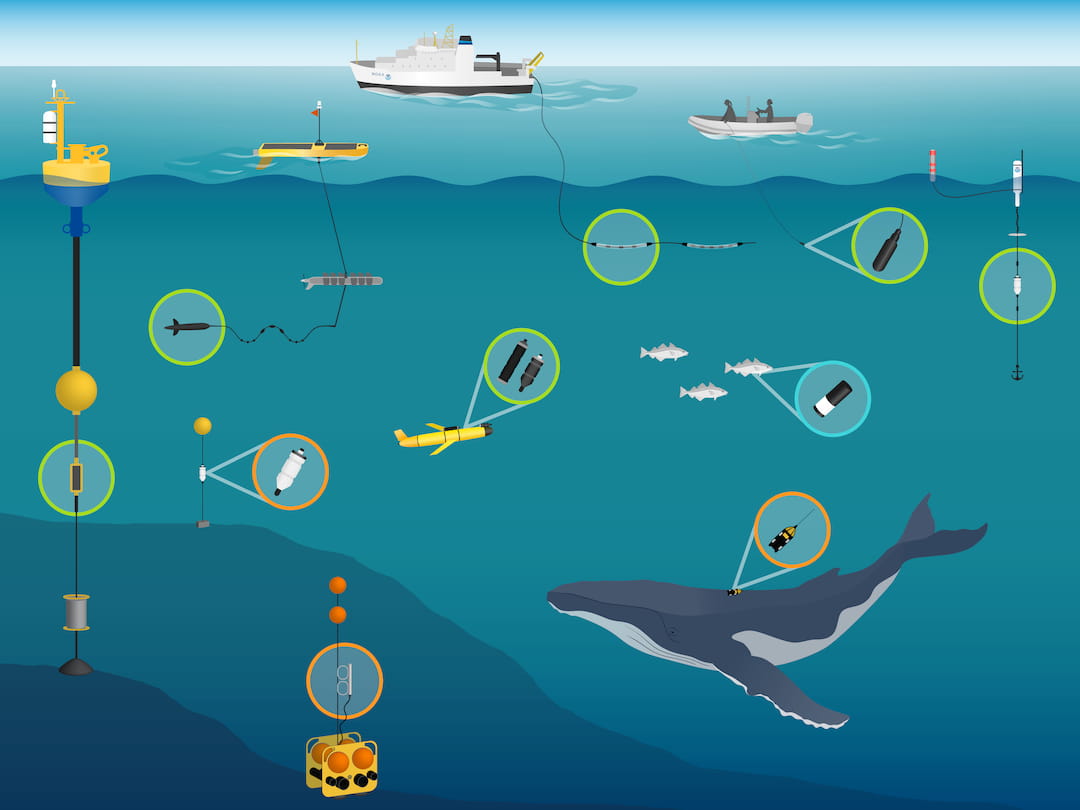
Researchers study marine animals by using a variety of technologies to record underwater sounds, including archival passive acoustic recordings (orange), real-time acoustic data collection (green), and active acoustics (blue). Image courtesy NOAA Fisheries.