



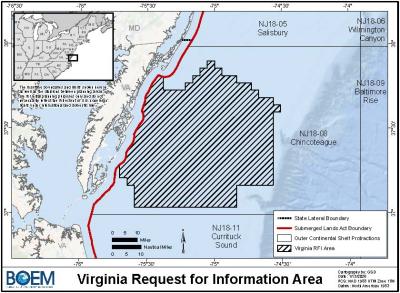
What's New?
On June 23, 2026, BOEM published a Request for Information and Interest (RFI) on potential leasing offshore Virginia. BOEM extended the public comment period on the RFI through August 22, 2026. Comments can be submitted or viewed at https://www.regulations.gov/document/BOEM-2026-0100-0001.
BOEM is evaluating whether to advance a competitive lease sale for minerals (other than oil, gas or sulfur) on the Outer Continental Shelf offshore the Commonwealth of Virginia. Federal regulations lay out a step-by-step path before any lease sale occurs. BOEM announced the publication of the Request for Information and Interest (RFI), identifying an initial area for comment. The purpose of this RFI is to evaluate industry interest and gather public input that could inform a potential lease sale for mineral.
If BOEM proceeds to the Area Identification phase of leasing, BOEM will prepare an environmental assessment and undertake consultations to analyze the action of leasing and authorization of preliminary activities. Preliminary activities include bathymetric, geological, geophysical, mapping, and other surveys necessary to develop a comprehensive Delineation, Testing, or Mining Plan. Such preliminary activities are those which have no significant adverse impact on the natural resources of the OCS. This environmental review will include necessary consultations under environmental and other statutes including Section 7 of Endangered Species Act, Section 106 of the National Historic Preservation Act, and Section 307 of the Coastal Zone Management Act.
BOEM's Regulatory Pathway for Outer Continental Shelf (OCS) Minerals Leasing For Virginia
Request for Information and Interest
Published in the Federal Register.
Identification of Areas
Based on interest received during the RFI, BOEM announces areas to be considered for potential leasing.
Environmental Analysis
BOEM’s scientists and other environmental specialists analyze the potential environmental impacts of a minerals lease sale encompassing the identified areas.
Proposed Leasing Notice
Published in the Federal Register.
Leasing Notice
Published in the Federal Register.
Competitive Lease Sale
BOEM evaluates bids and may award leases.
What are Heavy Mineral Sands?
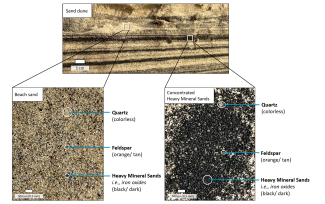
Heavy mineral sands are naturally occurring coastal or offshore sediment deposits enriched in dense minerals such as ilmenite, rutile, leucoxene, and zircon—geologic minerals essential for producing titanium, zirconium, and other critical metals and materials used in modern technologies. These minerals form when waves and currents concentrate heavier sediments into distinct layers, creating coastal and marine resources of strategic importance. Virginia sands are composed lighter colored sediments consisting of quartz, feldspars, and some shell fragments, while colocated heavy minerals have distinctive darker colors. When heavy mineral sands are concentrated, they may still contain small fractions of quartz, feldspars, and shell fragments.
Virginia Department of Energy, 2024
Phosphorites
Phosphorites are marine sedimentary deposits enriched in phosphate minerals—primarily carbonate fluorapatite—that form on continental margins and seafloor environments where ocean conditions concentrate phosphorus over long periods. These deposits can host important nutrients and, in some regions, elevated levels of rare earth elements, making them a potential strategic mineral resource. Phosphorite sediments may co-occur in offshore sand deposits.
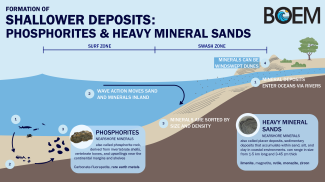
Additional information on heavy mineral sands from the U.S. Geological Survey:
- Critical Mineral Resources in Heavy Mineral Sands of the U.S. Atlantic Coastal Plain | U.S. Geological Survey
- Heavy-Mineral Sand Resources in the Southeastern U.S. | U.S. Geological Survey
- Deposit Model for Heavy-mineral Sands in Coastal Environments | U.S. Geological Survey
Resource Evaluation Research
BOEM funds mineral resource evaluation research that collects information about seabed deposits and critical minerals to support future decisions concerning potential OCS minerals leasing, exploration, and development.
Some examples of BOEM-funded studies related to seabed minerals in Virginia include:
2024
A capacity assessment on the recovery of critical and economic minerals from sand used for coastal resilience projects Nelson, M, et al.
Analysis of critical and strategic mineral recovery from sand used for beach nourishment Virginia Department of Energy Geology and Minerals Resources Program (GMRP)
2023
BOEM Resource Evaluation of Critical and Hard Offshore Mineral Programmatic Reference (RECHOMPR)
2022
Proceedings of the 2022 Mid-Atlantic Marine Heavy Minerals Sands Forum Hawkins, D, et al.
2019
Heavy mineral distributions in offshore sediments using Q-mode factor analysis Berquist Jr., C; Boon, J
Economic heavy minerals on the continental shelf offshore of Virginia: New insights into the mineralogy, particle sizes, and critical element chemistry Lassetter, W; Blanchette, J
2016
Grain size distribution and heavy minerals content of marine sands in federal water offshore of Virginia Berquist Jr., C, et al.
Assessment of offshore sand resources and economic heavy minerals on Virginia's outer continental shelf VADMME (Virginia Department of Mines, Minerals, and Energy)
2012
1988
Study of economic heavy minerals of the Virginia inner continental shelf Berquist, C; Hobbs III, C
Reconnaissance of economic heavy minerals of the Virginia inner continental shelf Berquist, C; Hobbs III, C
1986
Assessment of economic heavy minerals of the Virginia inner continental shelf Berquist, C; Hobbs III, C
Environmental Studies
BOEM funds environmental studies that collect information about the marine environment to support future decisions concerning potential OCS minerals leasing, exploration, and development. For more information, please visit Marine Mineral Environmental Studies | Bureau of Ocean Energy Management.
Some examples of BOEM-funded studies related to seabed minerals in Virginia include:
2020
2014
2013
Review of biological and biophysical impacts from dredging and handling of offshore sand Michel, J, et al.
2010
Investigation of dredging guidelines to maintain and protect the integrity of offshore ridge and shoal regimes/detailed morphologic evaluation of offshore shoals Mohammad, D and Nairn, R
2006
Comparisons between marine communities residing on sand shoals and uniform-bottom substrates in the Mid-Atlantic Bight Slacum, H, et al.
1999
Use of Federal offshore sand resources for beach and coastal restoration in New Jersey, Maryland, Delaware, and Virginia Reidenauer, J, et al.
1998
Heavy Mineral Sand Exploration and Recovery
To map and explore these resources, scientists use well-established, tools, including geophysical surveys and geotechnical sampling. Lease issuance only allows lessees to conduct preliminary mapping activities and submit a separate plan for subsequent review approval before any extraction occurs. If leasing occurs and, after plan submission and approval, if dredging were to occur, the heavy mineral sands would be likely collected using hopper dredge equipment similar to that used in other navigation channel dredging and coastal protection projects. After dredging, the material would likely be taken to a land-based facility, where the minerals would be separated and processed. Processing is not expected to occur at sea at this time.
Related Announcements
- Bureau of Ocean Energy Management Seeks Public Input on Potential Mineral Leasing Offshore Virginia
- BOEM seeks public input on potential Alaska minerals lease sale
- BOEM Advances Offshore Minerals Planning Efforts in American Samoa and the Commonwealth of the Northern Mariana Islands
Resources
- BOEM Critical Minerals (BOEM’s national critical minerals webpage)