



The Outer Continental Shelf Lands Act provides the legal framework for how the nation manages energy and mineral resources beyond state coastal waters. These federal waters—known as the Outer Continental Shelf—cover three to 200 nautical miles from shore and total some 3.2 billion acres. The OCS contains vast areas of seabed and subsoil that hold important energy, mineral, and geological resources. Management of these areas falls under the Bureau of Ocean Energy Management and the Bureau of Safety and Environmental Enforcement, bureaus within the Department of the Interior responsible for offshore planning and oversight.
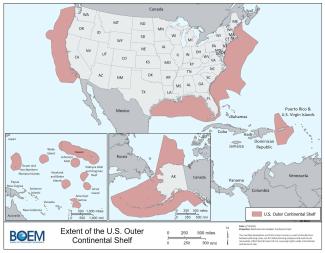
Congress enacted OCSLA in 1953 to establish a clear federal system for offshore resource development as activities were growing rapidly. The law affirmed federal jurisdiction over mineral resources on the OCS and directed the Department of the Interior to oversee leasing, environmental review, safety, and long-term stewardship. Today, we continue this mission—integrating scientific expertise, environmental protection, engineering review, and operational oversight to ensure offshore activities are safe, responsible, and aligned with national priorities.
Although OCSLA is the central statute governing offshore energy and mineral development, it is supported by a broad network of environmental and coastal laws. These include requirements for comprehensive environmental analysis, coordination among federal agencies, consultation with coastal states and Tribal Nations, and meaningful opportunities for public participation. This layered system ensures that decisions about offshore development consider ecological protection, community interests, and long-term environmental sustainability.
OCSLA’s core principles guide how BOEM and BSEE evaluate offshore activities. The law requires offshore development to be carried out safely and in an orderly manner, with strong safeguards for the environment and offshore workers. It also ensures conservation of natural resources and a fair return to the public from the use of shared offshore lands. These principles support transparency and accountability in managing federal resources held in trust for the American people.
Under OCSLA, the federal government maintains a competitive offshore leasing framework. For offshore oil and gas, the statute requires the development of a five-year National Oil and Gas Leasing Program that outlines where and when potential lease sales may occur. This long-term planning process helps ensure clarity for industry, coastal states, Tribal partners, and the public, while allowing time for robust environmental review and public comment.

OCSLA has evolved significantly since its passage. Amendments made in 1978 strengthened environmental safeguards, bolstered coastal state involvement, increased safety and inspection requirements, and reinforced long-term planning through the five-year program. The Energy Policy Act of 2005 further expanded OCSLA’s scope to include renewable energy activities such as offshore wind, wave, and ocean current energy. These updates reflect the changing landscape of offshore energy and the need for modern tools to manage emerging technologies and resources.
OCSLA works alongside some of the nation’s most important environmental and coastal statutes, including the National Environmental Policy Act, Coastal Zone Management Act, Clean Air Act, Endangered Species Act, and Marine Mammal Protection Act. These laws guide our evaluations, ensuring that offshore activities are reviewed holistically and with the best available science. Together, they form a comprehensive legal framework that protects coastal ecosystems, supports responsible development, and promotes transparency in federal decision-making.
Through OCSLA and its related laws, BOEM and BSEE manage offshore resources with a commitment to environmental stewardship, operational safety, scientific integrity, and public trust. This unified system ensures that offshore development—whether for conventional energy, renewable energy, or critical minerals—proceeds in a manner that serves the long-term interests of the nation and its coastal communities. As reunification of the bureaus into the Marine Minerals Administration proceeds, we will not waver in meeting these important commitments.

-- BOEM --
The Department of the Interior’s Bureau of Ocean Energy Management (BOEM) manages development of U.S. Outer Continental Shelf (OCS) energy, mineral, and geological resources in an environmentally and economically responsible way.